

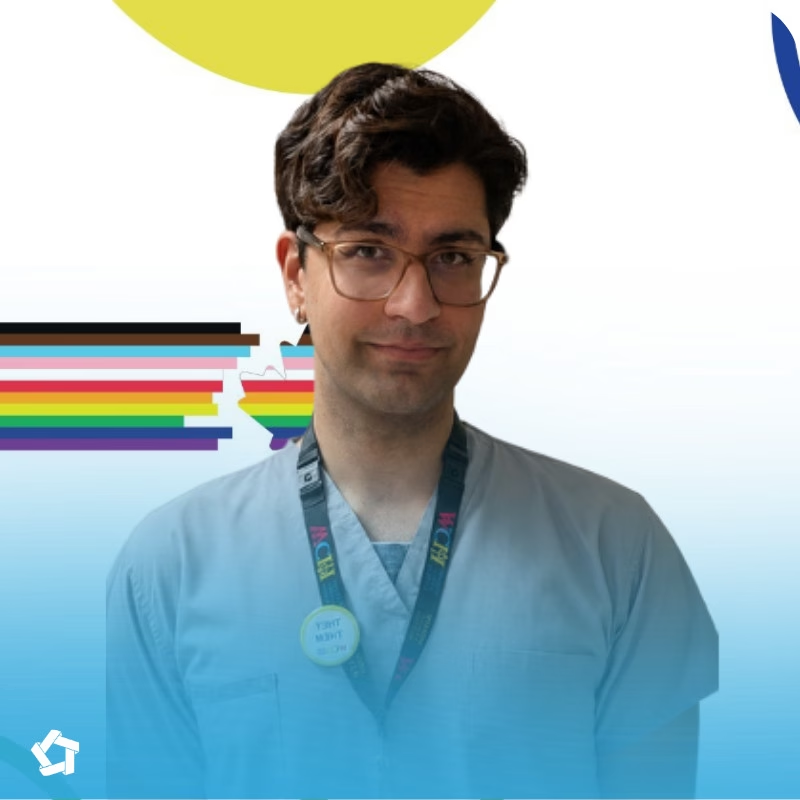
From advocating for gender-diverse communities to presenting their research on the state of gender-affirming plastic surgery, Shad 2019 alum and third-year medical student Solana Vellani-Husein (They/Them) shares just how meaningful community consultation is in the classroom.
The first few years of medical school are all about building a base foundation of knowledge. It’s a weaving tapestry of lectures and cases that equip students with the necessary information to enter clinical spaces with a diverse array of patients, each with a unique set of needs.
As a third-year student at the UBC Faculty of Medicine, Solana Vellani-Husein (They/Them) is calling attention to the training gaps that exist across these lectures and cases, specifically when it comes to gender-affirming care.
Gender-affirming medical care can come in many different forms, from hormone replacement therapy to genital reassignment surgery, but the results remain the same: they support and affirm a person’s identity, providing a level of care that can be life changing and life saving.
In many schools across the country, Solana says this training is treated as an add-on, an extra self-learning module distinct from the rest of the lecture or a topic that only highly-interested students are versed in.
While there are specialists in Canada doing amazing work in these spaces, it’s still an incredibly under-resourced area. There are only three main centres across the entire country equipped to perform gender-affirming surgeries, wait times for care being as long as 30 months.
That’s why Solana is pushing for curriculum changes at the local level, and creating a roadmap to a standardized curriculum from coast to coast.
Solana met with two separate leaders at the University of British Columbia and Simon Fraser University, sharing curriculum recommendations in an open and collaborative conversation.
“From first year into second year, we’re taught not just how to carry out a physical exam on a patient, but how to carry out a history, and have a conversation with a patient to understand their concern and the holistic situation around themselves and what brought them in,” says Solana. “As part of that, there was a session on interviewing Queer patients because of course, there are very unique needs around that.”
Among other recommendations, Solana suggested that the 2SLGBTQI+ community should be consulted for this lesson so the language is accurate, up-to-date, and truly reflective of gender-diverse identities.
Solana is a member of the UBC Steering Committee for the Canadian Queer Medical Students Association, a network of 2SLGBTQI+ and ally medical students dedicated to Queer health education and advocacy. Through this, they helped establish the first Queer orientation event at UBC and have also hosted several social events, reaching and supporting medical students from all four years.
Solana has also been heavily involved in research as well, conducting a literature review in their undergraduate studies on the changes in care that patients experienced during the pandemic, and is currently presenting their research, Enhancing Gender-affirming Surgical Education: A Cross-Canada Initiative In Plastic Surgery, at conferences in Kelowna and Los Angeles.
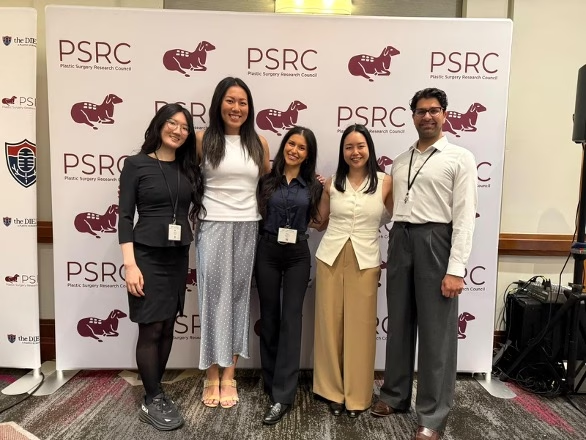
“We reached out to program directors about what training they were providing and then we also reached out to the actual trainees, the residents as they’re called,” says Solana. “We asked them not just about what type of training they were getting but what their perspectives were on gender-affirming care overall, what their confidence was after receiving training, and what they thought some of the major gaps were that they would prefer to have filled.”
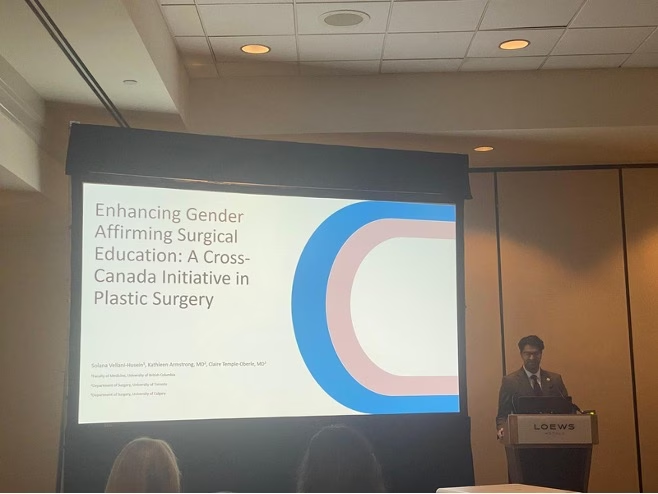
While this project did show that trainees at least knew about the existence of gender-affirming care, it revealed that there is still a long way to go.
Over the next year, Solana and their supervisor plan to ask curriculum experts in each realm of gender-affirming surgery to record didactics in their specialty.
“Rather than having a specialist at each university before they have the resources to hire those people, we can set up an online repository that schools can pull from and integrate into their curriculum and get some exposure to start with.”
While some students will have their first exposure this way, Solana’s discovery of gender-affirming care wasn’t through a lesson. It was deeply personal, the result of coming out during their third year of undergraduate studies. As they researched about gender-diverse communities, they learned more about themselves and also more about gender-affirming care.
“That’s how I figured out that gender-affirming care was its own distinct specialty. I didn’t know that prior to coming out and doing any of that research.”
Prior to that time, Solana already had their sights set on medical school, a stable path that their dad had already charted as a pediatric surgeon.
“But you always have to figure out your own reason.”
While there were glimmers of other career options and pursuits growing up, medical school was always in the back of Solana’s mind, even before attending Shad at Dalhousie University in 2019.
“Shad showed me that there were other pathways in STEM that I could explore, and then undergrad allowed me to actually explore that to a much deeper level because it’s more than a month,” says Solana. “That’s where public health entered the picture.”
Instead of selecting a subject explicitly in the biomedical space for their undergraduate studies at Wilfrid Laurier University, Solana opted to study Health Sciences with a focus on Public Health.
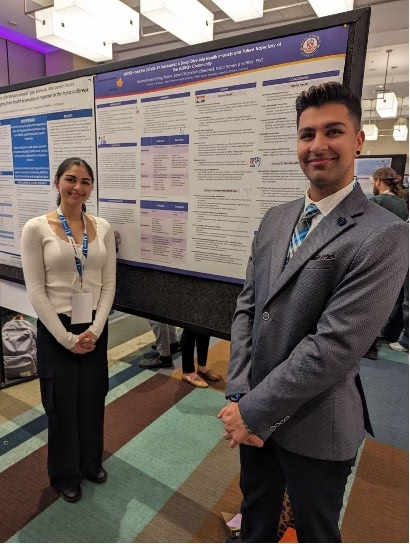
This allowed Solana to explore medicine through a lens that wasn’t necessarily medical, learning things like how discrimination and generational violence can actually manifest on a biological level.
“If you look at the generations of those whose parents or grandparents went to the residential school system, there is an increased rate of diabetes within that population…,” says Solana.
”Epigenetics is something that is key within that because these are individuals who didn’t experience it themselves. It was their parents or grandparents.”
Solana continued to explore medicine through this social lens by completing a Graduate Diploma in Global Surgery: Surgical Care Systems & Health Equity at McMaster University on top of their medical school studies. In the program, they learned how to build sustainable surgical care systems in areas that don’t have them yet.
It’s been fulfilling, says Solana, to connect their interests in surgery and public health, but learning wasn’t always like this. Growing up, it was something that always came naturally to Solana, they didn’t have to invest a lot of time in the classroom.
“Shad was the first moment where I entered a space and I actually needed to think, and it wasn’t for grades. It gave me an opportunity to reflect on what I was doing and why I was doing it.”
After seeing so much learning and emotional growth in themselves during the program, Solana returned to Shad as a Program Assistant for three separate years, to mentor and hopefully inspire a new generation of Shads.
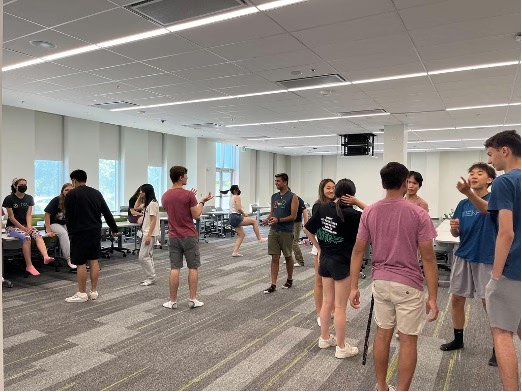
Solana says that at least six of these students who attended Shad Dalhousie have reached out to them directly to ask questions about applying to medical school.
“The fact that I was able to make them feel comfortable enough to reach out to me, even after it’s been years since they were at Shad, I like to think that it means I was successful.”
Now in their third year, Solana is currently taking part in clinical rotations, but as the year comes to an end, they will start thinking about electives and applying to schools with the hope of specializing in plastic surgery. Upon getting in and then completing that residency, they hope to secure a fellowship in gender-affirming surgery, joining other surgeons who are making a life-changing, life-saving impact.