
Tell us a little about yourself.
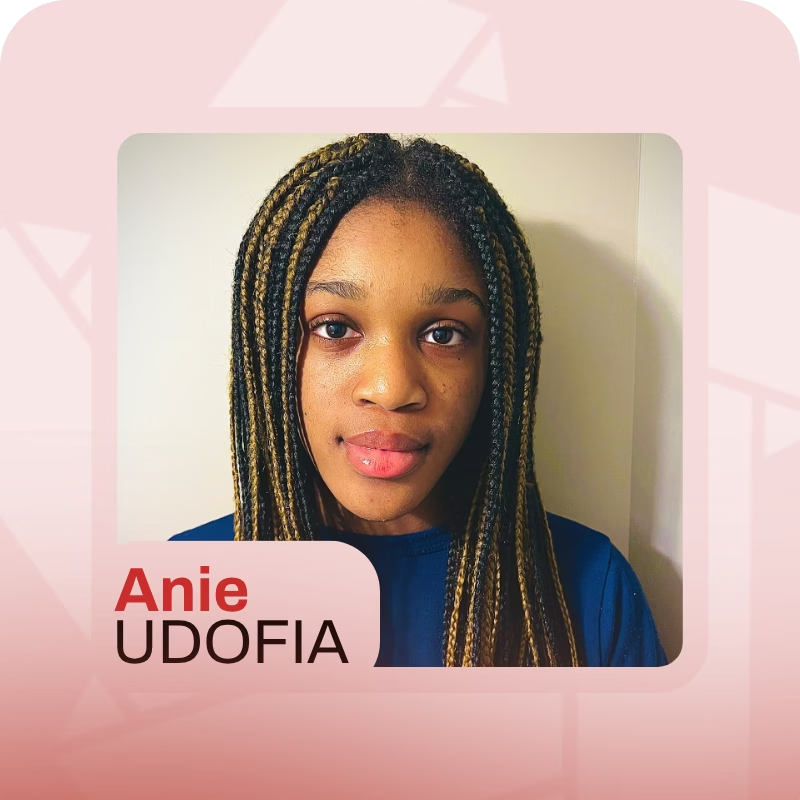
I’m a Grade 10 French Immersion student from Calgary, Alberta who is passionate about healthcare innovation, artificial intelligence, and early disease detection. I enjoy exploring how technology can improve patient outcomes and make healthcare more accessible. Through research projects, STEM initiatives, and community outreach, I’ve had the opportunity to share my passion for science while encouraging other young people to explore innovation and problem-solving.
Pourquoi avez-vous hâte de participer à Shad ? Qu'attendez-vous le plus avec impatience ?
I’m excited to join a community of students from across Canada who are curious, creative, and motivated to make a difference. I look forward to collaborating with people from diverse backgrounds, tackling real-world challenges, and learning more about entrepreneurship and innovation. I’m especially excited to explore how ideas can move from a concept to something that creates meaningful impact in communities.
Qu'est-ce qui éveille votre curiosité ou votre intérêt pour le STIAM et/ou l'entrepreneuriat ?
My curiosity comes from wanting to understand how science and technology can be used to solve important healthcare challenges. Over the past few years, I’ve worked on projects focused on early disease detection, including AI tools for skin disease identification/profiling and a prototype lung screening system. These experiences gave me the opportunity to present my research on a national stage at the Canada-Wide Youth Science Fair and showed me how innovation can connect research, technology, and patient care. They also sparked my interest in entrepreneurship, because creating a solution is only the first step. This ensures that it has the potential to reach and benefit the people who need it.
Comment envisagez-vous votre avenir ?
I hope to pursue a career as a medical diagnostic radiologist while continuing to contribute to healthcare innovation through research and technology. I’m particularly interested in medical imaging and how emerging technologies such as artificial intelligence can support earlier and more accurate diagnoses. In the future, I hope to help develop technologies that improve disease detection, advance patient care, and make healthcare more accessible to communities around the world.